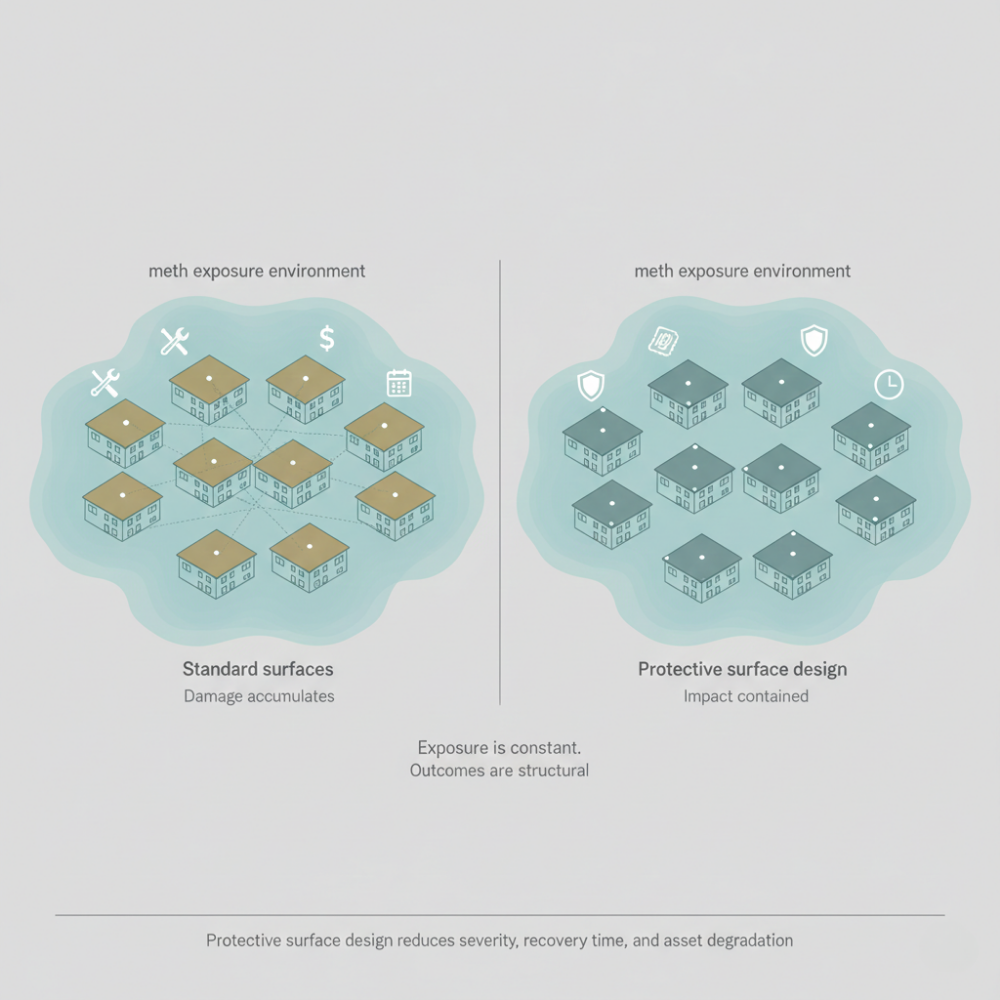
Meth Harm in Housing Is Structural — Why Protective Surface Design Matters
Housing providers don’t struggle because meth contamination occurs — they struggle because of how buildings respond when it does.
Meth contamination in housing is often treated as an isolated event — something that appears, is addressed, and resolved.
Operational evidence from housing portfolios shows something different.
Meth-related harm is structural. By structural, we mean it arises from the operating environment and asset design, not from individual sites or isolated incidents. It reflects how buildings adsorb, absorb and retain, or resist repeated exposure over time.
The severity of impact is not driven by behaviour alone, but by surface design and material response.
Understanding this distinction reframes the role of protective coatings — not as a clean-up solution, but as a preventive design control.
Exposure is persistent, not exceptional
Portfolio-level data shows that meth exposure is not confined to older or poorly maintained housing stock.
In one monitored social housing portfolio of 52 units, five separate contamination events occurred within the first 18 months of operation — equating to almost three events per year. Importantly, the housing stock itself was relatively new.
Sat alongside a wider analysis of meth testing results and wastewater testing data that shows how meth use has increased in New Zealand, these experiences challenge the assumption that contamination is primarily a legacy problem. Instead, it reflects a broader reality:
In some housing environments, meth exposure is part of the operating context.
Where exposure is persistent, the key question is not if contamination occurs — but how severely it manifests when it does.
How meth damages buildings
Meth contamination causes damage through two physical mechanisms:
Adsorption
Residues adhere to surface finishes. This drives:
- Persistent surface contamination
- Repeat intervention
- Ongoing operational disruption
Adsorption is a feature of non-porous surfaces ad those which have low porosity. Some surfaces of this type, particularly timber with a clear coat, varnish like finish, have a particular affinity for meth contamination and can be very difficult to decontaminate.
Absorption
Residues penetrate porous materials beneath the surface. This drives:
- A greater likelihood of invasive remediation
- Removal of finishes and potentially linings
- Extended vacancy is more likely
- Capital loss will be higher
Traditional responses focus on restoring habitability using the same material types after these mechanisms have occurred. Adopting this approach does not change how future exposure will affect the asset.
This is where advanced coating solution systems, that protect the property come in.
What protective surface coatings change
Protective coatings do not prevent meth use.
They change how meth exposure translates into damage.
A properly engineered protective surface:
- Reduces residue adhesion (adsorption) to the surface
- Prevents penetration into underlying materials (adsorption)
- Limits contamination to a cleanable, non-porous layer
- Enhances cleanability,
- Eliminates the need to use aggressive chemicals that damage standard paints
- Cuts down time and cost associated with decontamination and reinstatement
This interrupts the pathway from exposure to structural damage and substantially reduces operational costs.
In practical terms, this means contamination events are far more likely to be managed as clean-and-reinstate events, rather than rebuild-style recoveries. Faster recovery also reduces the risk of residual exposure for future occupants.
Protective coatings are not a complete solution to the meth problem, but they materially change how meth related behaviour affects assets — thereby shifting the balance in favour of housing service providers who wish to support people trapped in dependent meth use habits.
Why this is a structural improvement
In the same 52-unit portfolio, a typical unprotected contamination event involved testing, remediation, refurbishment, and vacancy, with direct costs typically running into tens of thousands of dollars per event.
The critical insight is not the cost itself, but why the cost escalates. Once residues build up on and absorb into materials, recovery becomes more invasive and disruptive, with effective decontamination outcomes harder to achieve..
By limiting adsorption and absorption, protective coatings reduce:
- Event severity
- Recovery time
- Asset degradation
Importantly, the decontamination process does not affect the integrity of the protective coating. So the operational improvements continue to be felt, even when exposure to meth related behaviour continues.
Protective surface design does not deny risk. It prevents risk from compounding.
Asset protection and housing stability
Protective coatings deliver a secondary but essential benefit: they preserve asset viability.
Viable assets allow housing providers to:
- Maintain financial predictability
- Increase the likelihood assets remain insurable
- Operate in higher-risk environments
- Avoid unnecessary displacement of vulnerable tenants
This stability is what enables sustained support for people with complex needs. Without asset protection, tolerance for risk can collapse due to the damage their behaviours cause to the property asset— and housing and social outcomes deteriorate accordingly.
A design decision, not a maintenance task
Surface protection is often framed as a maintenance or remediation consideration. If it is being contemplated at the same time as remediation, it certainly becomes a natural extension of decision making. The time is right to takes steps to avoid a repeat.
In reality though, used of advanced protective coatings is a system design decision:
- Should exposure repeatedly convert into capital loss?
- Or should it be contained at the surface and be able to be cleaned away easily?
Protective coatings shift that balance.
They do not eliminate meth exposure.
They ensure the likelihood meth exposure will require decontamination is reduced and if contamination reaches the point where action needs to be taken, the time and cost to decontaminate is substantially reduced and the integrity of the housing asset is protected.