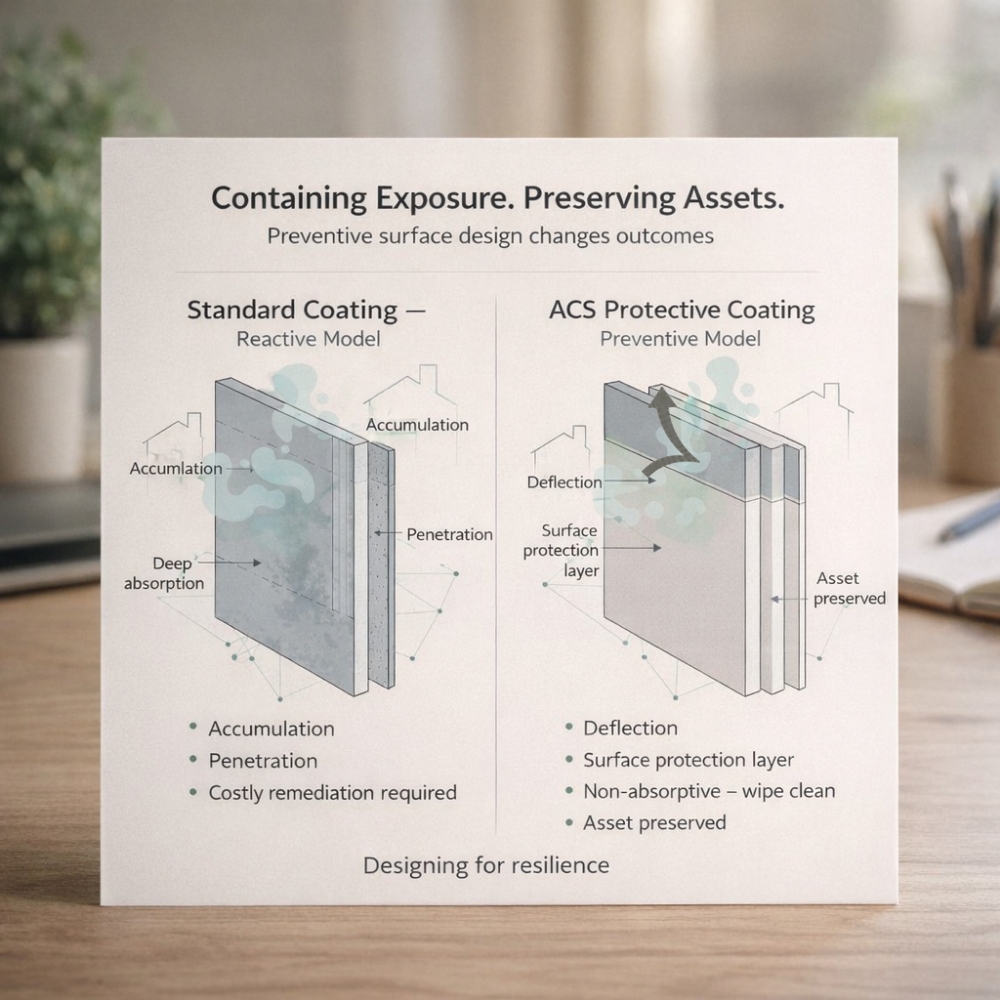
Containing Exposure to Meth Contamination Damage, Preserving Assets — Why Preventive Design Changes Outcomes
Between the start of 2023 and the end of 2024, the amount of methamphetamine being used in New Zealand doubled. There has been a four fold increase in meth use since 2019. This means the likelihood of contamination events is increasing. Results from the meth testing industry confirm this.
Results from the meth testing industry also identify that the severity of those contamination events is also on the increase.
In many housing environments, meth exposure is common, albeit the behaviour is unpredictable and/or poorly controlled.
As a result of these realities housing systems increasingly operate in conditions where exposure is uneven, persistent, and often outside the direct control of providers. In many instances, it is a case of when contamination will arise, not if.
In these environments, outcomes for all stakeholders depend less on whether exposure occurs, and more on how assets respond when it does.
That distinction matters — because it shifts the problem from tenant behaviour and enforcement to management process and building design and resilience.
Preventive surface design reframes the challenge from reacting to damage to reducing the potential for surfaces to be damaged and containing impact when it does.
The focus of the advanced coating system solutions offered by ACSare not about preventing exposure; but limiting escalation of damage and reducing the consequences of loss when damage occurs.
The limits of a reactive operating model
Under a reactive operating model:
-
- Each contamination event is treated as a discrete failure
-
- The interaction between methamphetamine vapour and different material types is not considered at the design phase
-
- Surfaces are restored, but exposure pathways remain unchanged
-
- Subsequent events often escalate more quickly as a result of accumulation of meth residues
Over time, this produces:
-
- Repeated capital loss
-
- Increasing vacancy
-
- Greater tenant disruption
-
- Rising operational strain
Portfolio analysis consistently shows that even moderate event frequency can accumulate into substantial long-term exposure. In comparable housing portfolios, the implied economic impact over time can run into tens of thousands of dollars per property. Even under conservative assumptions, for larger portfolios of property, this means millions of dollars of economic risk exposure, for a risk that few housing providers are actively managing.
While active management can bring this risk exposure down, the nature of meth use and the behaviour of users, means that while the likelihood of loss can be reduced, it can never be eliminated.
So, how does a housing service provider reduce their economic risk exposure to methamphetamine related behaviour?
What preventive surface design does differently
Advanced coating solution systems do not control behaviour. They change how exposure interacts with the built environment. Application of and in so doing can reduce both the likelihood of damage occurring.
Specifically, they:
-
- Limit residue adhesion (adsorption)
-
- Block penetration into porous materials (absorption)
-
- Make residue removal easier – saving time and money on decontamination
-
- Preserve substrates beneath the surface – reducing the cost of reinstatement
This keeps contamination events within a recoverable operating envelope — meaning disruption is contained rather than compounded.
Instead of triggering invasive remediation, events can often be managed through targeted cleaning and verification, allowing faster reinstatement and less disruption to both tenants and providers.
Outcomes still depend on exposure occurring — but escalation is no longer automatic.
Why early containment matters
In practice, contamination requiring formal action is often the final signal in a longer sequence of issues.
Before that point, providers may already have managed:
-
- Disruptive behaviour
-
- Neighbour complaints
-
- Property damage
-
- Rent arrears
When systems can only respond late, options narrow and outcomes harden.
Preventive surface design slows the conversion of exposure into damage, preserving flexibility on the part of the housing service provider earlier in the tenancy lifecycle. That optionality is critical for proportionate response, continuity of housing, and stability for occupants.
Asset protection underpins capacity to support
Housing providers can only support people with complex needs if their assets remain viable.
When assets degrade rapidly:
-
- Financial exposure concentrates
-
- Risk tolerance declines
-
- Tenancies end sooner
-
- Displacement increases as does the harm that comes from this
Protective coatings reduce this pressure by preserving asset condition and predictability. This is not a social policy intervention — it is an engineering control that enables stable operation which supports and often enables the social policy adopted by the housing service provider.
Preserved assets allow systems to stay engaged longer, rather than retreating under cumulative loss.
A quiet alignment with regulatory intent
Regulatory frameworks may redefine when contamination requires action, but they do not change the underlying exposure environment.
Preventive surface design complements this reality by ensuring assets are better able to resist accumulation and escalation. This reduces the likelihood that regulatory thresholds are reached in the first place.
In that sense, protective coatings reduce reliance on blunt intervention by containing harm before it becomes severe.
From reaction to resilience
Other persistent risks in housing — moisture, corrosion, fire — are managed through design controls rather than repeated repair.
Meth exposure can be no different if the realities are accounted for in building design and choice of surface coating.
The question is not whether risk exists, it patently does, but whether assets are designed to:
-
- Resist exposure to repeated harm, and/or
-
- Contain it and remain functional
Advanced coating solutions systems, make both these options available to property owners and housing service providers.
Conclusion: a more resilient system
Protective coatings do not solve meth use.
They solve a more practical problem:
-
- How exposure translates into damage
-
- How often housing is disrupted
-
- How long assets remain viable
-
- How damage is addressed
-
- How much it costs to address the damage
By restricting contamination to the surface, preventive design preserves the function, value, and stability of housing assets over time, reducing the harm caused by meth related behaviour.
Over time, this shift from reaction to resilience becomes a defining feature of sustainable housing systems.
That is the outcome that matters.